When the building has to be empty, the channel still has to be on air
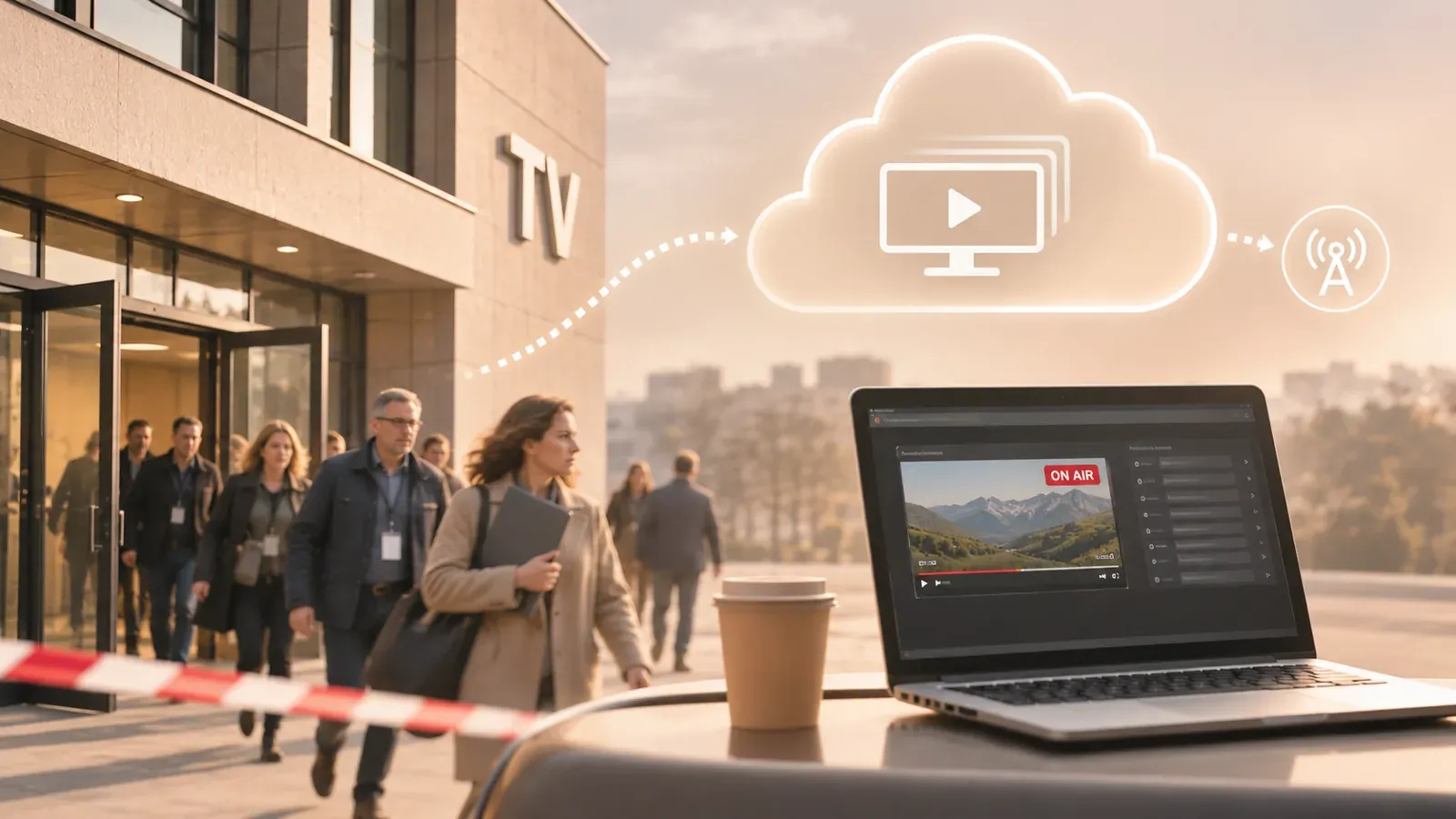
On Friday 6 November 2026, newsrooms across Europe received emailed bomb threats warning that “the clock is ticking.” Ireland’s public broadcaster RTÉ evacuated its Dublin campus, including radio and television presenters. Police searched Bulgarian broadcaster Nova TV’s newsroom in Sofia. Sky in the UK confirmed it had received a threat and reported it to the authorities. In Ireland, Virgin Media, Newstalk and the Irish Independent also received hoax claims.
No device was found. The emails followed a week of similar hoax threats against passenger flights across Europe, and the Irish government described the activity as likely a coordinated campaign.
The outcomes differed. Nova TV kept its programming running while the newsroom was checked. At RTÉ, programming was suspended during the evacuation and, according to reports, some services carried music and pre-recorded announcements for a time.
Evacuating was the right call. No broadcaster should keep people in a building that may contain a bomb. The question for everyone else is a different one: if your staff have to leave the building in the next five minutes, what happens to your channel?
The threat did not touch a single server
Most broadcast disaster recovery planning starts from technical failure: a playout server, a storage array, a power supply or an encoder. Most serious broadcasters have redundancy for that, often a second chain in the same rack or building.
These threats broke no equipment. They removed the people. A fire alarm, a flood, a police cordon or a power cut to the street has the same effect. The playout may still be running, but nobody can stay in the control room to operate it, and a backup chain in the same building is evacuated with the main one.
Redundancy that shares a location with the main system protects against equipment failure. It does not protect against losing access to the location.
What DR that survives an evacuation needs
The backup playout runs somewhere else. Not a second rack in the same building, and ideally not in the same city. A cloud DR channel runs in a cloud region, away from the broadcaster’s own sites.
Operators can run it from anywhere. If the backup can only be controlled from inside the facility, it fails with the main system. Operators who have just left the building need to start and run it from a laptop in the car park, at home or in another office.
The backup has real programming, not just a slate. Music and a holding card keep a signal on air, but they do not hold an audience. A DR channel with the current schedule and content can carry on with something close to the normal output.
How Veset Nimbus does this
Veset Nimbus is cloud playout that runs on AWS by default. Operators need only a web browser and an internet connection, and the channel can also be run through the REST API or by an AI agent through the Nimbus MCP server.
For broadcasters whose main playout is on-premises, Nimbus works as a cloud DR channel:
- Schedule and content are ready in advance. Nimbus imports BXF, XML, XLSX, CSV and JSON playlists, so your traffic system can feed the DR channel. DR content is never removed by library cleanup, so it is there when you need it.
- The DR playout runs only when needed. An operator starts it from the console, the REST API or MCP, and it is on air within minutes. Your headend or MCR then switches to the DR feed.
- Operators work from anywhere. They can change the playlist, apply the emergency playlist, take or skip events and bring in live sources from any browser.
For channels that run on Nimbus full time, there is also 1+1 hot backup, warm standby and multi-region HA.
Latvian Television and TV Azteca both run disaster recovery channels on Nimbus.
Five questions to ask your team this week
- If the building is evacuated now, which of our channels stay on air, and with what?
- Does any part of our backup depend on being inside the building, including its controls?
- Who can switch to the backup, and can they do it from a laptop outside?
- Is the backup’s schedule and content current?
- When did we last switch to the backup for real, and how long did it take?
If the answer to any of these is “we’re not sure”, that is the place to start. To talk through a DR setup for your channels, get in touch.